
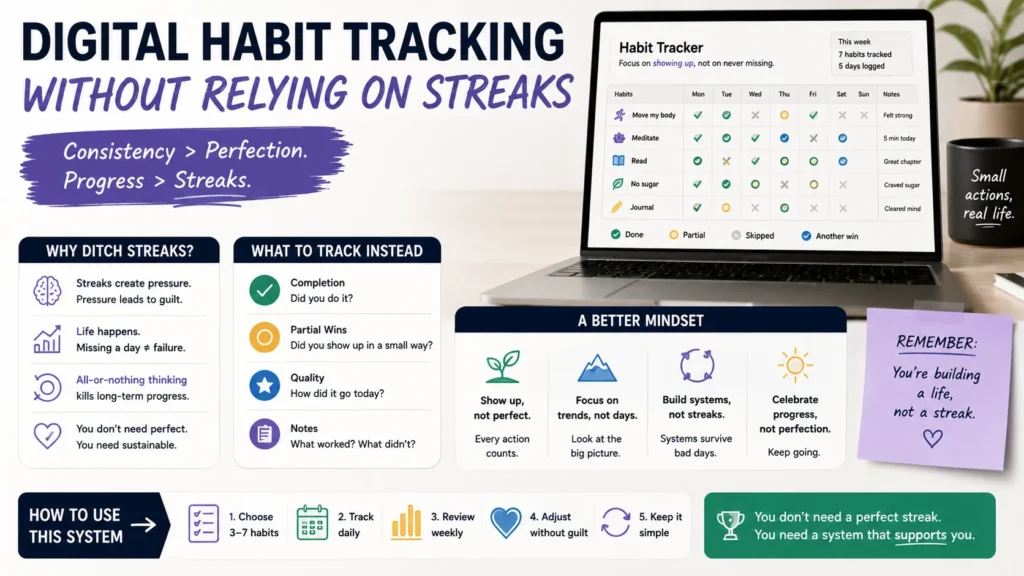
Miss one day on a streak-based habit app and the whole thing resets to zero. For a lot of people, that single broken chain is enough to make them quit the app entirely, not just the habit. Digital habit tracking without relying on streaks is a different approach: instead of chasing an unbroken count, you log behavior, review patterns, and adjust, without a red notification guilting you back into the app.
This matters more than it sounds. Streak counters were built to boost daily active users, not to help anyone actually change their behavior. A missed Tuesday shouldn’t erase three months of progress, and it shouldn’t feel like it does either.
Below is a practical guide to tracking habits digitally without leaning on streaks: what to measure instead, which apps and setups support it, and how to build a system that survives a bad week.
Why Do Streaks Backfire for So Many People?
Streaks work by triggering loss aversion. Once a chain gets long, the fear of losing it becomes the main motivator, not the value of the habit itself. That’s a fragile kind of motivation. It works right up until life gets in the way, a trip, an illness, a chaotic week at work, and then it collapses all at once.
There’s also the all-or-nothing trap. A habit tracked as a binary streak has no room for “I did half of it” or “I did it differently today.” Someone who walks 20 minutes instead of their usual 40 still gets marked as a failure, which quietly teaches the brain that partial effort doesn’t count.
Behavioral researcher Katy Milkman has pointed out that constant streak pressure can shift a person’s focus from wanting to succeed to simply not wanting to fail. Those aren’t the same thing, and only one of them builds a habit that lasts.
- Read Also: How to Build a “Brain Dump” System (Works in Any Tool)
- Read Also: A Task System for People Who Have Tried Every App and Nothing Works
What Should You Track Instead of a Streak?
If not a streak count, then what? A few metrics hold up better over the long run:
- Frequency ratio: completions divided by opportunities (e.g., 4 out of 7 days), which absorbs the occasional miss without zeroing anything out
- Consistency over a rolling window: a 30-day completion rate instead of a lifetime streak, so a bad week ages out naturally
- Context tags: noting where, when, or under what conditions a habit happened or didn’t, which turns tracking into a diagnostic tool instead of a scoreboard
- Effort level: a simple 1-3 rating for how the habit felt that day, since “did it, but it was rough” is useful data a streak can’t capture
- Trend direction: is the rolling average going up, flat, or down over the last few weeks, which matters more than any single day
None of these punish a missed day. They all treat one bad day as a data point, not a failure.
Which Habit-Tracking Tools Support Non-Streak Methods?
Several apps and setups are built around frequency and pattern tracking rather than daily chains. Here’s how the main options compare:
| Tool | Core Method | Best For | Cost |
| Loop Habit Tracker | Frequency-based scoring, not strict daily | Budget-conscious Android users who want flexible goals |
Free, open source
|
| Finch | Self-care check-ins tied to a virtual pet, no visible streak counter | People who want gentle accountability without pressure |
Free with optional in-app purchases
|
| Way of Life | Long-range calendar view, chains are visual but not punitive | Spotting patterns over months, not daily pressure | Freemium |
| Notion or Airtable template | Fully custom database with rolling averages and tags | Anyone who wants total control over metrics | Free to low-cost |
| Strides | Multiple tracking types (target, streak-optional, project) | People juggling several habit formats at once | Freemium |
A private Notion or Airtable setup is worth calling out separately. Because you build the fields yourself, there’s no default streak widget nagging you, and you can log a rolling completion percentage instead of a chain. It takes more setup time than downloading an app, but it’s the closest thing to a tracker with zero built-in guilt mechanics.
How Do You Build a Habit System Around Frequency Instead of Streaks?
Start with the goal, not the count. Decide what “consistent enough” looks like for this specific habit, three times a week for strength training, five days for a reading habit, daily for medication. Frequency targets should match the habit’s real-world logic, not an arbitrary daily requirement.
Log the miss the same way you log a win. If you skip a day, note why in a word or two: traveled, sick, overslept. Over a month, that short note turns into a pattern you can actually act on, instead of a blank space you feel bad about.
Review weekly, not daily. Checking a rolling percentage once a week keeps the focus on trend rather than obsessing over a single day’s result. Daily streak-checking is exactly the behavior that made streak apps addictive in the first place; a weekly review breaks that loop.
Automate the logging, not the guilt. A Shortcut, Tasker rule, or Zapier trigger that logs a habit automatically (say, when you arrive at the gym’s Wi-Fi network) removes friction without adding a reminder that scolds you.
Let effort count. If a habit was harder than usual and you still showed up, that’s worth noting as a win, not diluting into the same checkbox as an easy day.
Set a floor, not a ceiling. Instead of aiming for 100% completion, pick a realistic target like 70-80% and treat anything above that as a bonus. This changes the psychology of a missed day: you’re not breaking a perfect record, you’re still on pace for a target you planned to hit less than perfectly in the first place.
What Does the Research Say About Non-Streak Tracking?
Most of the evidence on habit formation points to consistency and cue-based repetition, not unbroken chains, as the thing that actually builds automaticity. A single missed day, according to the habit-formation literature that grew out of University College London’s work on habit strength, barely dents long-term formation. What actually derails a habit is the emotional spiral that follows a missed day, not the miss itself.
That’s the real argument against streaks: they turn a neutral event, one skipped day, into an emotional one. Removing the counter doesn’t remove accountability. It just moves the accountability from a red banner to a weekly look at your own data.
- Read Also: How to Build a Weekly Planning System That Actually Sticks
- Read Also: Best Second-Brain Systems Compared: Notion, Obsidian, and Logseq
Frequently Asked Questions
Is it bad to use a streak-based app if it’s working for me?
No. If a streak keeps you consistent and you don’t feel anxious about breaking it, there’s no reason to switch. The frequency-based approach is mainly useful for people who’ve quit apps before after a broken streak.
Can I track habits without any app at all?
Yes. A simple spreadsheet or even a paper calendar with tally marks works, as long as you’re reviewing a percentage over time rather than counting consecutive days.
Do habit tracking apps without streaks still send reminders?
Most do, but the better ones let you separate reminders from progress tracking, so a missed notification doesn’t also feel like a failed streak.
How long does it take to see a pattern using frequency tracking?
Give it at least three to four weeks. Weekly percentages are noisy at first; a monthly rolling average is where real patterns, like which days you consistently skip, start to show up.
