Category: Workflow Systems

  • Digital Habit Tracking Without Relying on Streaks

    Digital Habit Tracking Without Relying on Streaks

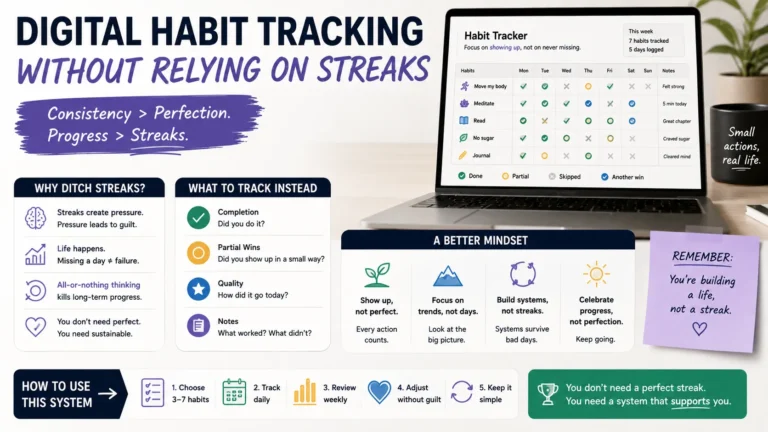
    Miss one day on a streak-based habit app and the whole thing resets to zero. For a lot of people, that single broken chain is enough to make them quit the app entirely, not just the habit. Digital habit tracking without relying on streaks is a different approach: instead of chasing an unbroken count, you log behavior, review patterns, and adjust, without a red notification guilting you back into the app.

    This matters more than it sounds. Streak counters were built to boost daily active users, not to help anyone actually change their behavior. A missed Tuesday shouldn’t erase three months of progress, and it shouldn’t feel like it does either.

    Below is a practical guide to tracking habits digitally without leaning on streaks: what to measure instead, which apps and setups support it, and how to build a system that survives a bad week.

    Why Do Streaks Backfire for So Many People?

    Streaks work by triggering loss aversion. Once a chain gets long, the fear of losing it becomes the main motivator, not the value of the habit itself. That’s a fragile kind of motivation. It works right up until life gets in the way, a trip, an illness, a chaotic week at work, and then it collapses all at once.

    There’s also the all-or-nothing trap. A habit tracked as a binary streak has no room for “I did half of it” or “I did it differently today.” Someone who walks 20 minutes instead of their usual 40 still gets marked as a failure, which quietly teaches the brain that partial effort doesn’t count.

    Behavioral researcher Katy Milkman has pointed out that constant streak pressure can shift a person’s focus from wanting to succeed to simply not wanting to fail. Those aren’t the same thing, and only one of them builds a habit that lasts.

    What Should You Track Instead of a Streak?

    If not a streak count, then what? A few metrics hold up better over the long run:

    • Frequency ratio: completions divided by opportunities (e.g., 4 out of 7 days), which absorbs the occasional miss without zeroing anything out
    • Consistency over a rolling window: a 30-day completion rate instead of a lifetime streak, so a bad week ages out naturally
    • Context tags: noting where, when, or under what conditions a habit happened or didn’t, which turns tracking into a diagnostic tool instead of a scoreboard
    • Effort level: a simple 1-3 rating for how the habit felt that day, since “did it, but it was rough” is useful data a streak can’t capture
    • Trend direction: is the rolling average going up, flat, or down over the last few weeks, which matters more than any single day

    None of these punish a missed day. They all treat one bad day as a data point, not a failure.

    Which Habit-Tracking Tools Support Non-Streak Methods?

    Several apps and setups are built around frequency and pattern tracking rather than daily chains. Here’s how the main options compare:

    Tool Core Method Best For Cost
    Loop Habit Tracker Frequency-based scoring, not strict daily Budget-conscious Android users who want flexible goals
    Free, open source
    Finch Self-care check-ins tied to a virtual pet, no visible streak counter People who want gentle accountability without pressure
    Free with optional in-app purchases
    Way of Life Long-range calendar view, chains are visual but not punitive Spotting patterns over months, not daily pressure Freemium
    Notion or Airtable template Fully custom database with rolling averages and tags Anyone who wants total control over metrics Free to low-cost
    Strides Multiple tracking types (target, streak-optional, project) People juggling several habit formats at once Freemium

    A private Notion or Airtable setup is worth calling out separately. Because you build the fields yourself, there’s no default streak widget nagging you, and you can log a rolling completion percentage instead of a chain. It takes more setup time than downloading an app, but it’s the closest thing to a tracker with zero built-in guilt mechanics.

    How Do You Build a Habit System Around Frequency Instead of Streaks?

    Start with the goal, not the count. Decide what “consistent enough” looks like for this specific habit, three times a week for strength training, five days for a reading habit, daily for medication. Frequency targets should match the habit’s real-world logic, not an arbitrary daily requirement.

    Log the miss the same way you log a win. If you skip a day, note why in a word or two: traveled, sick, overslept. Over a month, that short note turns into a pattern you can actually act on, instead of a blank space you feel bad about.

    Review weekly, not daily. Checking a rolling percentage once a week keeps the focus on trend rather than obsessing over a single day’s result. Daily streak-checking is exactly the behavior that made streak apps addictive in the first place; a weekly review breaks that loop.

    Automate the logging, not the guilt. A Shortcut, Tasker rule, or Zapier trigger that logs a habit automatically (say, when you arrive at the gym’s Wi-Fi network) removes friction without adding a reminder that scolds you.

    Let effort count. If a habit was harder than usual and you still showed up, that’s worth noting as a win, not diluting into the same checkbox as an easy day.

    Set a floor, not a ceiling. Instead of aiming for 100% completion, pick a realistic target like 70-80% and treat anything above that as a bonus. This changes the psychology of a missed day: you’re not breaking a perfect record, you’re still on pace for a target you planned to hit less than perfectly in the first place.

    What Does the Research Say About Non-Streak Tracking?

    Most of the evidence on habit formation points to consistency and cue-based repetition, not unbroken chains, as the thing that actually builds automaticity. A single missed day, according to the habit-formation literature that grew out of University College London’s work on habit strength, barely dents long-term formation. What actually derails a habit is the emotional spiral that follows a missed day, not the miss itself.

    That’s the real argument against streaks: they turn a neutral event, one skipped day, into an emotional one. Removing the counter doesn’t remove accountability. It just moves the accountability from a red banner to a weekly look at your own data.

    Frequently Asked Questions

    Is it bad to use a streak-based app if it’s working for me?

    No. If a streak keeps you consistent and you don’t feel anxious about breaking it, there’s no reason to switch. The frequency-based approach is mainly useful for people who’ve quit apps before after a broken streak.

    Can I track habits without any app at all?

    Yes. A simple spreadsheet or even a paper calendar with tally marks works, as long as you’re reviewing a percentage over time rather than counting consecutive days.

    Do habit tracking apps without streaks still send reminders?

    Most do, but the better ones let you separate reminders from progress tracking, so a missed notification doesn’t also feel like a failed streak.

    How long does it take to see a pattern using frequency tracking?

    Give it at least three to four weeks. Weekly percentages are noisy at first; a monthly rolling average is where real patterns, like which days you consistently skip, start to show up.

  • How to Build a Brain Dump System (Works in Any Tool)

    How to Build a Brain Dump System (Works in Any Tool)

    You know the feeling: you’re in the shower, or half-asleep, or stuck in a meeting, and a thought shows up that has nothing to do with what you’re doing. A client follow-up you forgot. An idea for a side project. The fact that you’re out of dish soap. Your brain surfaces it at the worst possible time, and then either you lose it, or it just sits there looping until you can write it down.

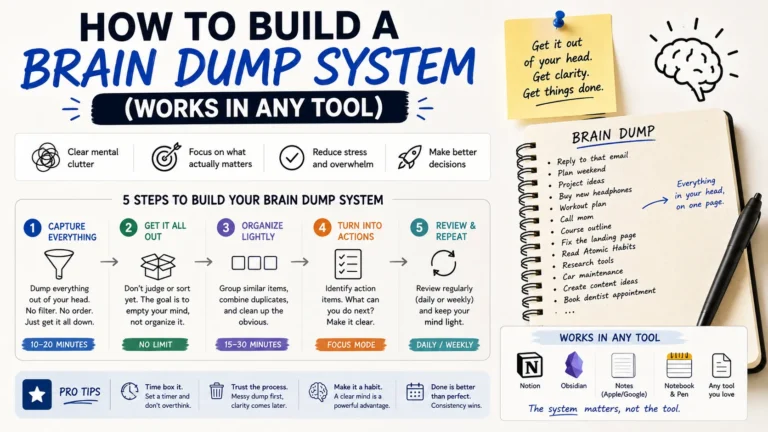
    A brain dump system fixes that. It’s not a specific app and it’s not a personality type thing, it’s a habit: one place where anything goes the moment you think of it, and a separate step later where you actually deal with it. Below is a version of the system that works whether you’re using Notion, Apple Notes, a Field Notes notebook, or nothing more than the Reminders app you already have open.

    What a brain dump system actually is

    Most people who try this fail for one of two reasons. Either capturing something takes too many steps, so they skip it in the moment and the thought is gone. Or they try to decide “where does this go?” while they’re still mid-thought, which turns a five-second jot into a five-minute filing project, and eventually they stop bothering.

    The fix is separating two jobs that people usually smash together: capture and processing. Capture should take seconds and require zero decisions. Processing happens later, on a schedule, when you’re not also trying to remember what you were doing before the thought interrupted you.

    The four-stage system

    1. Capture: one inbox, no filing

    Pick a single place that catches everything, unsorted. This matters more than which app you pick. A voice memo, a note on your phone’s lock screen widget, a running Google Doc, the back of a receipt in your pocket, it doesn’t matter, as long as it’s the one place you actually reach for without thinking.

    The only rule: write it down raw. No tags, no folders, no “is this a task or an idea” debate. That’s a later problem.

    2. Process: a scheduled sort, not a constant one

    Set aside time, daily if your inbox fills up fast, two or three times a week if it doesn’t, to go through everything you dumped and ask one question per item: what is this, and does it need an action?

    Four buckets cover almost everything:

    Bucket What goes here
    Where it lives after processing
    Do Anything with a next action
    Your task list or calendar
    Reference Info worth keeping but no action needed
    Notes or a wiki page
    Someday/Maybe Ideas worth revisiting, not now
    A running backlog list
    Trash Most things, honestly Deleted

    That last row surprises people the first time they process a dump. Roughly half of what felt urgent at 2am reads as irrelevant by Thursday. That’s not a failure of the system, it’s the system working.

    3. Organize: add structure after, never during

    Once something’s been triaged, give it a home. This might be as simple as a couple of Notion pages, or as basic as three folders in Apple Notes. Resist the pull to build an elaborate tagging scheme before you’ve processed a single item. A six-category system gets used. A twenty-category system gets abandoned by week three, and you end up back at square one with a pile of unsorted notes and a folder structure nobody opens.

    4. Reflect: a weekly check-in

    Systems like this decay quietly. You stop emptying the inbox, the Someday/Maybe list turns into a graveyard, and eventually the whole thing just becomes another notes app you feel vaguely guilty about. A short weekly review heads that off:

    • Skim Someday/Maybe. Anything become relevant? Anything gone stale enough to cut?
    • Check whether the inbox actually got emptied this week, not just glanced at.
    • Look for repeats. If you keep dumping the same kind of thing (client emails you need to follow up on, recurring errands), that’s a sign you need a dedicated bucket, or an automation, for that category specifically.

    Setting it up in whatever tool you already use

    You don’t need to switch apps to do this. The four stages above are deliberately generic so they map onto almost anything.

    • Notion or Obsidian: one Inbox database or page as the capture point, a status property (Do, Reference, Someday, Trash) to process, and separate databases or pages for the organized material.
    • Apple Notes or Google Keep: a single pinned note as your inbox. During processing, move lines out into other notes or folders, then clear the inbox note.
    • A task manager like Todoist or Things: an Inbox project everything lands in by default. Processing is just triaging into real projects, or deleting.
    • Paper: a dedicated notebook section reserved only for the dump. Processing means transcribing or checking things off during your weekly review.
    • Automation-heavy setups: if you already use something like Zapier or N8N, the inbox can be a form, a specific Slack channel, or an email address that auto-routes into a database.

    A quick example

    Say you’re a freelancer juggling three clients. Over a Tuesday you jot into your phone’s Inbox note: “ask Dana about the invoice,” “cool headline idea for the Q3 newsletter,” “look into that new email tool,” and “buy dog food.” On Thursday’s processing session, “ask Dana” becomes a task due Friday, the headline idea goes into a Someday/Maybe doc for content ideas, “look into email tool” gets fifteen minutes on the calendar next week, and “buy dog food” gets deleted because you already went to the store Wednesday. None of that required a complicated app. It required a place to dump and a scheduled ten minutes to sort.

    Common mistakes that kill the habit

    • Treating the inbox as permanent storage. If you stop emptying it, it stops working as a capture tool and starts working as anxiety in list form.
    • Over-categorizing at capture time. The whole point is that capture is fast. If you’re deciding folder placement while jotting something down, you’ve merged the two steps back together.
    • Skipping the weekly review. This is the step people cut first when busy, and it’s the one that keeps the whole system from rotting.
    • Chasing the perfect app instead of starting. A basic note pinned to your home screen today beats a beautifully designed Notion template you get around to building next month.

    Frequently Asked Questions

    What’s the difference between a brain dump and a to-do list?

    A to-do list only holds things you’ve already decided are tasks. A brain dump catches everything, tasks, ideas, half-formed thoughts, before you’ve sorted out what it even is.

    How often should I do a brain dump?

    Capture happens continuously, any time a thought shows up. Processing is the scheduled part, daily works well for people with a lot flowing through, two or three times a week is plenty for lighter use.

    Do I need a special app for this?

    No. The system is the four stages, not the tool. Apple Notes, a Notion database, and a paper notebook all work fine as long as you actually use whichever one you pick.

    Can I combine a brain dump with GTD or another productivity method?

    Yes, and a lot of people already do without naming it that. The capture-then-process split described here is essentially a lighter version of the “capture” and “clarify” stages from Getting Things Done, adapted to work without needing to adopt the whole methodology.

    Where to go from here

    Pick one tool, the one that’s already open on your phone most, and pin a blank note or page to it right now. Give yourself permission to dump into it messily for a week before worrying about categories at all. The system gets built by using it badly at first, not by planning it perfectly.

  • How to Build a Weekly Planning System That Actually Sticks

    How to Build a Weekly Planning System That Actually Sticks

    We’ve all been there. You buy a new planner or build the perfect Notion setup, feeling like you’ve finally got your life together. Then a few weeks later, it’s collecting digital dust. Sound familiar?

    The problem isn’t you. Most weekly planning systems are too complicated to survive real life. This guide shows you a simple system that still works when your week goes completely off the rails.

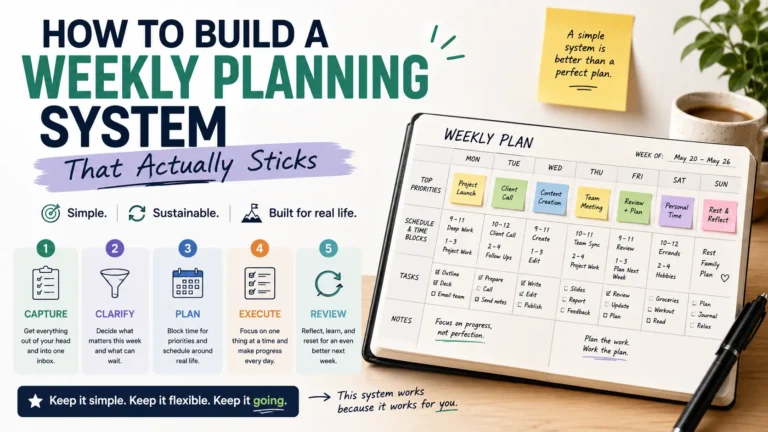
    By the end, you’ll have an easy five-step planning system you can set up in under an hour and actually stick with.

    Why Do Most Weekly Planning Systems Fall Apart?

    Three things kill a planning habit, and it’s rarely the tool.

    • Over-planning. You block every hour of every day, and the first unplanned meeting knocks the whole week sideways. Once the schedule breaks, most people just stop opening the planner.
    • No fixed trigger. “I’ll plan when I have time” isn’t a system, it’s a hope. Without a specific day and time, weekly planning competes with everything else and usually loses.
    • Planning tasks instead of priorities. A 40-item to-do list feels productive to write and miserable to face. If nothing on the list is ranked, everything ends up equally urgent, which means nothing actually is.

    A weekly planning system that sticks solves for all three at once: fewer decisions, a fixed cue, and a short list of things that actually matter.

    What Does a Weekly Planning System That Sticks Actually Look Like?

    Five parts, done in roughly 30 minutes, at the same time every week.

    1. Pick One Anchor Time

    Sunday evening or Monday morning both work. What matters is that it’s the same slot every week, tied to something that already happens, like your first coffee or your commute home. Habit research calls this a cue, and it’s the piece most DIY systems skip entirely.

    2. Do a Two-Minute Brain Dump

    Before you plan anything, get whatever’s rattling around your head out of it. Open a blank note and write down every task, worry, and half-finished idea for 90 seconds. Don’t sort it yet. The point is just to clear working memory so the planning that follows isn’t competing with a mental backlog.

    3. Pick Three Priorities, Not Thirty Tasks

    Look at your brain dump and your calendar, then choose three outcomes for the week, not three tasks. “Ship the client proposal” is an outcome. “Open Google Docs” is not. Three is small enough to actually finish and big enough to matter. If a fourth thing feels urgent, ask whether it can wait, get delegated, or get cut.

    4. Time-Block the Priorities First, Everything Else Second

    Put your three priorities on the calendar before anything else goes on it, ideally in your highest-energy hours. Meetings and admin work fill in around them, not the other way around. This single reordering is the difference between a week that runs you and a week you run.

    5. Run a Five-Minute Weekly Review

    At the end of the week, before you plan the next one, ask three questions: What actually got done? What kept sliding? What made this week harder or easier than expected? The review is the step almost everyone skips, and it’s the one that makes the whole system self-correcting instead of static.

    What a Sample Week Actually Looks Like

    Abstract advice is easy to nod along to and hard to copy. Here’s what the five-part system looks like for someone juggling a full-time job and a side project.

    Sunday, 6:30 PM, right after dinner: fifteen minutes of brain dump, then a look at next week’s calendar. Three priorities get written on a sticky note stuck to the laptop: finish the client deck, hit three workouts, and reply to the two emails that have been sitting for a week.

    Monday morning, the deck work gets a 90-minute block from 9:00 to 10:30, before Slack notifications start piling up. Workouts go on the calendar for Tuesday, Thursday, and Saturday, not “whenever there’s time,” because “whenever” rarely shows up. The two overdue emails get five minutes on Monday at 8:45, before anything else.

    Thursday is left mostly open. No pre-scheduled deep work, just room for whatever Monday’s plan didn’t account for, because something always comes up.

    Sunday again, before the next brain dump: what got done (the deck, two of three workouts), what slid (one email, still), and why (it needed input from someone else who was out sick). That last detail changes next week’s plan. The email gets rescheduled with a note to follow up by Wednesday instead of waiting.

    Nothing here requires a $40 planner or a color-coded dashboard. It requires the same 30 minutes, on the same day, five weeks running.

    Weekly Planning Methods Compared

    Not every method fits every schedule. Here’s how the common approaches stack up.

    Method Best for Setup time Main risk
    Paper planner (Full Focus, Passion Planner) People who want tactile, low-distraction planning Low
    Easy to lose or forget on travel days
    Notion/digital dashboard People already living in their apps and calendars High initially
    Customization becomes its own time sink
    Simple 5-step system (above) Anyone who’s tried and abandoned a more complex system Low
    Requires real discipline on the fixed weekly cue
    Time-blocking only, no weekly review People who want structure without a full ritual Low
    Drifts without a check-in; hard to spot patterns

    If you’ve burned out on an overbuilt digital dashboard before, the simple system is usually the better starting point. You can always add tooling later once the habit itself is solid.

    How Do You Keep a Weekly Planning Habit From Fading After a Month?

    Most planning habits don’t die from a bad system, they die from a missed week that never gets rebooted. A few things help:

    • Keep the anchor time non-negotiable for the first six weeks. After that, occasional flexibility won’t break it.
    • Leave one buffer day. A Thursday with nothing pre-scheduled absorbs the inevitable fires without wrecking your priorities.
    • Watch your energy, not just your calendar. Scheduling deep work during your afternoon slump guarantees you’ll skip it.
    • Miss a week? Just resume next Sunday. Don’t try to “catch up” retroactively, that’s how the whole habit unravels.

    A field study on structured weekly planning found it reduced after-work rumination and left people with fewer carried-over unfinished tasks, but only when the planning was done consistently, not sporadically. Consistency is doing more work here than any specific template.

    Frequently Asked Questions

    How long should weekly planning take?

    Thirty to forty-five minutes is enough for most people. If it’s regularly taking over an hour, the system’s probably too complicated.

    What’s the difference between weekly planning and daily planning?

    Weekly planning sets direction and priorities; daily planning decides what happens in the next 24 hours within that direction. You need both, and neither replaces the other.

    Should I use a paper planner or a digital one?

    Whichever one you’ll actually open. Paper tends to stick for people prone to app-hopping; digital tends to win for people who live in their calendar anyway.

    Do I need a weekly review if I already do daily planning?

    Yes. Daily planning tells you what to do today. Only a weekly review shows you the pattern across five or six days, like the same task sliding for the third week running.

    Final Thoughts

    A weekly planning system doesn’t need to be elaborate to work, it needs to survive contact with a bad week. Pick one anchor time, dump your head clear, choose three priorities instead of thirty tasks, block them first, and close the loop with a five-minute review. Run that five-part cycle for six weeks straight before you decide whether it’s working. Most people never give a system that long, which is usually why it never gets the chance to stick.

  • Best Second-Brain Systems Compared: Notion, Obsidian, and Logseq

    Best Second-Brain Systems Compared: Notion, Obsidian, and Logseq

    You bookmark an article, forget why it mattered, and three weeks later you are back on Google looking for the exact same answer.

    Classic chaos. A second brain system fixes that by turning your notes into an external memory you can actually trust.

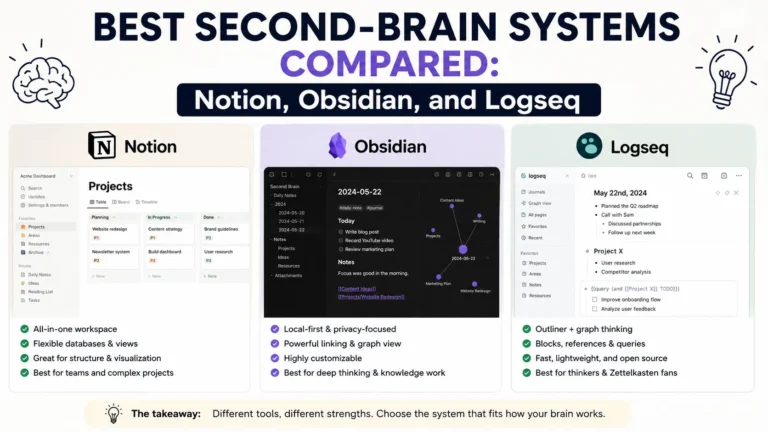
    Notion, Obsidian, and Logseq are the big three people fight over, and honestly, they all work differently.

    Pick the wrong one, and your note-taking life can turn into a ghost town fast.

    This guide breaks down how each one really works, where each one falls apart, and who it is actually built for.

    We tested all three with the same setup: daily notes, project pages, and a research stash of about 400 notes.

    The differences showed up almost immediately.

    What Makes a Second Brain System Actually Work?

    The idea traces back to Tiago Forte’s PARA method (Projects, Areas, Resources, Archives), though plenty of people build second brains without ever reading his book. The core promise is the same regardless of the app: offload information so your working memory can focus on decisions instead of recall.

    A system earns the name “second brain” when it does three things well.

    • Capture is frictionless. If saving a note takes more than a few seconds, you’ll stop doing it within a week.
    • Notes connect to each other. Isolated notes in folders are just a filing cabinet. A second brain links ideas so old notes resurface when they’re relevant.
    • Retrieval beats organization. You don’t need a perfect folder structure if search and backlinks can find the note for you.

    Notion, Obsidian, and Logseq all claim to do this. They disagree on how.

    How Does Notion Handle a Second Brain?

    Notion is a cloud-based workspace built around databases, not files.

    Pages can hold text, but also tables, kanban boards, and linked records, which makes it the closest thing to a project management tool with a notebook bolted on.

    For a second brain, that means you can build a PARA system with actual filters and views: a Projects database that rolls up tasks, an Areas database tagged by life domain, a Resources database you can filter by topic.

    If you like structure and you’re already comfortable with spreadsheets, this clicks fast.

    The tradeoff is speed. Notion pages load over the network, and heavy databases with hundreds of entries can lag, especially on mobile. It’s also cloud-only by default, so if Notion’s servers go down, so does your second brain.

    How Does Obsidian Handle a Second Brain?

    Obsidian stores everything as plain Markdown files on your own device. There’s no proprietary format, no server dependency, and no subscription required for personal use. The core feature that makes it a second-brain favorite is bidirectional linking: when you type [[note name]], Obsidian creates a link both ways, and a graph view shows how your notes cluster together.

    This is where Zettelkasten-style thinking shines. Instead of filing a note under one folder, you link it to five related ideas, and months later you rediscover the connection through the graph instead of hunting through a directory tree.

    Obsidian’s learning curve is steeper than Notion’s. There’s no built-in database view unless you install a community plugin like Dataview, and the interface rewards people who are willing to tinker. But because your notes are just files, you can back them up anywhere, sync them however you want, and never worry about a company shutting down and taking your archive with it.

    How Does Logseq Handle a Second Brain?

    Logseq is the outliner of the three. Every note is built from nested bullets rather than freeform paragraphs, and the app defaults to a daily notes page where you dump whatever’s on your mind, then link pieces of it to permanent topic pages later.

    If your thinking is naturally list-shaped, this workflow is fast. You don’t decide where a thought “belongs” before writing it down; you capture it in today’s log and connect it afterward. Logseq is also free and open source, stores files locally like Obsidian, and supports the same [[wiki-link]] syntax.

    The rough edges show up in polish. Logseq’s mobile app and sync have historically lagged behind Obsidian’s, and the plugin ecosystem is smaller. For a lot of users that’s a fair trade for paying nothing and owning their data outright.

    Which Second-Brain System Fits Your Thinking Style?

      Notion Obsidian Logseq
    Storage Cloud, proprietary Local Markdown files
    Local Markdown/Org files
    Structure Databases, pages Linked documents, graph view
    Outliner, daily notes
    Learning curve Low to moderate Moderate to steep Moderate
    Offline use Limited (needs sync) Full offline support
    Full offline support
    Price Free tier; paid plans from ~$10/user/month Free for personal use; sync/publish are paid add-ons
    Free, open source
    Best for Teams, project tracking, database-style thinkers Long-term archives, Zettelkasten, people who like tinkering
    Fast daily capture, list-shaped thinkers, privacy-first users

    If you’re choosing between Notion and Obsidian specifically: Notion wins for collaboration and structured project data, Obsidian wins for a private, durable knowledge archive you fully own. Logseq sits closest to Obsidian in philosophy but trades some polish for a faster daily-capture habit and a zero-dollar price tag.

    What Happens If You Switch Tools Later?

    This is the question most comparisons skip, and it’s the one that actually matters two years into a second-brain system. Notion locks your structure into its database format. Move away, and your relational properties, rollups, and formulas don’t survive the export; you’re left with flat Markdown files and a rebuild ahead of you.

    Obsidian and Logseq both avoid that trap because your vault is just a folder of .md files sitting on your hard drive. Delete the app tomorrow and your notes still open in any text editor. That’s not a small detail. A second brain you’re building for the next decade should survive the death of whichever company made the software.

    Cost adds up differently too. Notion’s paid plans run from roughly $10 to $20 per user per month depending on tier, which is fine for a team but adds up over years for a solo user. Obsidian is free for personal use, with optional Sync and Publish add-ons priced around $8 to $16 a month if you want them. Logseq stays free across the board, including its own sync feature, though it launched later and still lags Obsidian’s in reliability.

    Frequently Asked Questions

    Is Notion or Obsidian better for a second brain?

    Notion is better if you’re collaborating with a team or want database-style views of your notes. Obsidian is better for a personal, long-term knowledge archive that stays under your control, since it stores files locally rather than on someone else’s servers.

    Do I need to learn Markdown to use Obsidian or Logseq?

    Not really. Both apps let you type normally and handle the formatting behind the scenes for bold, links, and headers. Knowing basic Markdown syntax helps once you want more control, but it’s not a prerequisite to get started.

    Can I switch from Notion to Obsidian later without losing my notes?

    Yes, though it takes some cleanup. Notion can export pages as Markdown, and you can import that export into Obsidian’s vault folder. Database views and relational properties don’t translate directly, so expect to rebuild those manually.

    What is the PARA method, and do I need to follow it exactly?

    PARA stands for Projects, Areas, Resources, and Archives, a four-category system for organizing notes by actionability rather than topic. It’s a helpful starting structure, not a rulebook. Plenty of people modify it once they see how their own notes actually cluster.

    The Bottom Line

    There’s no universal best second-brain system, only a best fit for how you think. Pick Notion if you want structured databases and easy collaboration. Pick Obsidian if you want a durable, private archive with a graph view that rewards linking ideas together over time. Pick Logseq if daily capture matters more to you than polish, and you’d rather pay nothing than fight a subscription.

    Whichever one you choose, start smaller than you think you need to. Pick one note-taking habit, like a daily log or a single running project page, and build outward from there instead of trying to architect the perfect system on day one.