You open your to-do list, see “launch the website” or “plan the move” sitting there in one lonely line, and close the laptop again. Sound familiar? A 2025 look at ADHD coaching data found that vague, oversized tasks are one of the top reasons people freeze before they even start.
The problem usually isn’t motivation. It’s that your brain can’t find a door into the task. When a project stays one giant blob, there’s no obvious first move, so you stall, scroll, or reorganize your desk instead. Learning how to break down a big project into smaller steps fixes that, and it’s a skill, not a personality trait.
This guide walks through why big projects trigger overwhelm in the first place, and gives you a practical process for turning “revamp the website” into a list you can actually start today.
Why Do Big Projects Feel So Overwhelming?
Your working memory can only hold so much at once, roughly four to seven items according to most cognitive research. A big project doesn’t fit in that space. It arrives as a fuzzy cloud of deadlines, dependencies, and half-formed steps, and your brain treats that ambiguity as a threat rather than a task.
That’s why “clean the garage” feels heavier than it should. The task itself isn’t hard. What’s hard is holding twenty invisible sub-decisions in your head at the same time: where to start, what to keep, where the donation pile goes, whether you need bins. Once you write those decisions down as separate lines, each one gets easy. The overwhelm was never about effort. It was about the missing map.
There’s also a timing piece to this. Big, undefined tasks sit further away from any payoff, so your brain has less reason to engage with them right now. A single email reply pays off in two minutes. “Relaunch the brand” pays off in three months, if it pays off at all in your head today. Shrinking the project pulls the reward closer, which is a big part of why a broken-down list actually gets worked on instead of just admired from a distance.
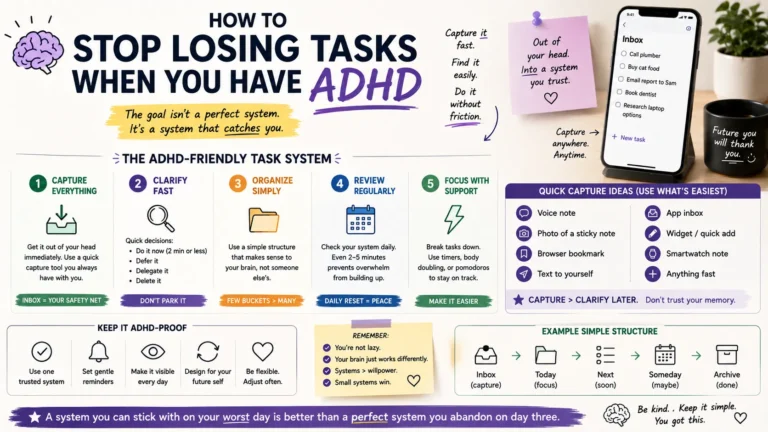
- Read Also: How to Stop Losing Tasks When You Have ADHD (Any App)
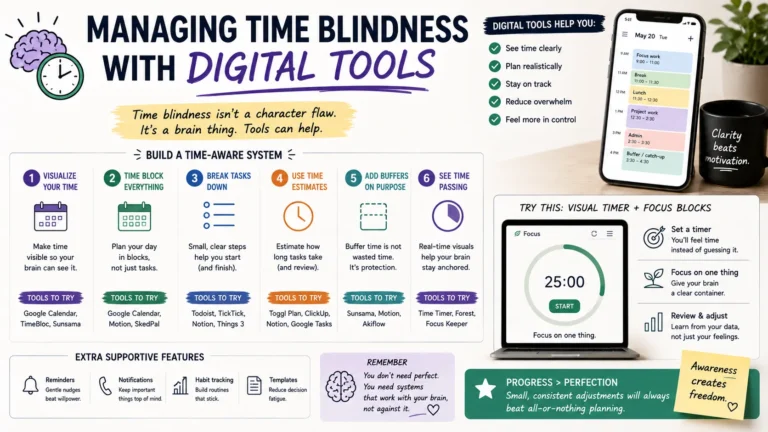
- Read Also: Managing Time Blindness with Digital Tools: A Step-by-Step Guide
How Do You Break a Project Into Smaller Steps?
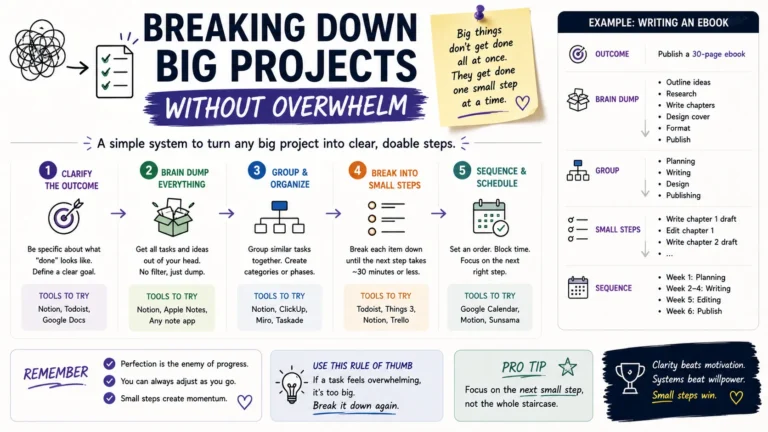
Start by writing down the finished result in one plain sentence, then work backward.
- Define the actual outcome. Not “improve the website,” but “publish 10 revised product pages by September 1.” A vague goal produces vague steps.
- Brain-dump everything that has to happen, in no particular order. Get it out of your head and onto paper before you try to organize it.
- Group the dump into phases. Research, drafting, review, and launch, for example.
- Shrink each phase into tasks small enough to finish in one sitting. If a task takes more than 90 minutes or you can’t picture doing it, split it again.
- Order the tasks by dependency, not by importance. Some steps can only happen after others; figure out that chain before you worry about priority.
- Assign a next action to the very top item. Not “start research,” but “open Google Docs and list five competitor sites.”
A task like “write the report” stays paralyzing because it hides five decisions inside one label. Broken apart, it looks more like this: outline the sections, draft the intro, pull three supporting stats, write section one, proofread. Each piece is small enough that starting doesn’t require willpower, just fifteen minutes.
| Vague Task |
Broken-Down Version
|
| Plan the move |
Get 3 moving quotes, book a date, pack the closet, label boxes by room
|
| Write the report |
Outline sections, draft intro, pull supporting data, write section 1, proofread
|
| Launch the website |
Finalize copy for homepage, choose 5 stock images, test checkout flow, schedule launch email
|
| Redo the budget |
List all expenses, categorize by fixed/variable, set 3 savings targets, pick a tracking app
|
What’s the Right Size for a Task?
A good rule of thumb: if you can’t picture the physical first move, the task is still too big. “Get healthier” isn’t a task, it’s a direction. “Walk 20 minutes on Tuesday and Thursday” is a task. Coaches who work with ADHD clients often use a simple test here: if a step still feels vague after you’ve broken it down once, break it down again until it does.
Aim for chunks that take somewhere between 15 and 90 minutes. Shorter than that and your list turns into busywork with too many entries to track. Longer than that and the old overwhelm creeps back in, because a 4-hour block still has hidden sub-steps buried inside it.
How Do You Stay on Track Once the Project Is Broken Down?
Breaking a project apart is only half the job. The other half is tracking progress without losing the thread.
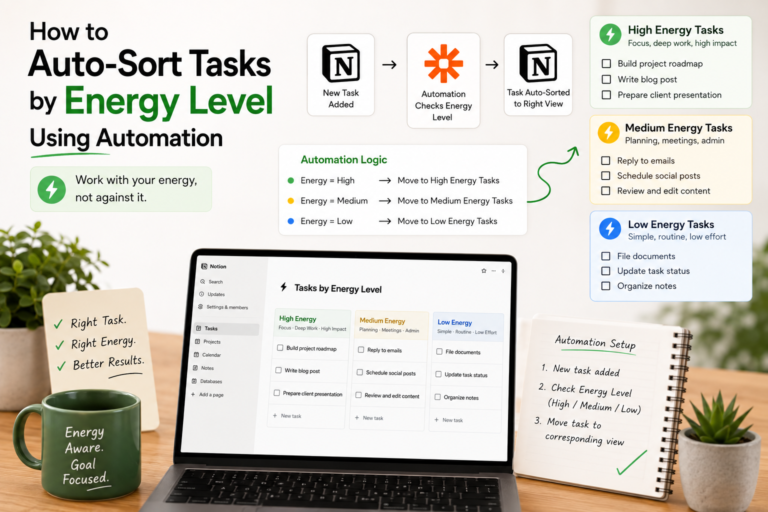
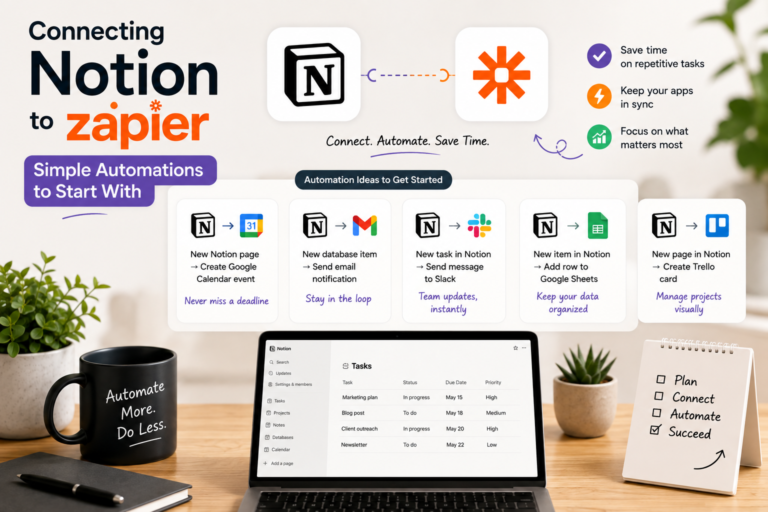
- Use one system, not five. A single running list in Notion, Trello, or even a plain notebook beats scattered notes across apps and sticky notes.
- Check off small wins visibly. Crossing an item off a physical or digital list gives a real, if tiny, sense of momentum, and that momentum is what keeps you moving to the next item.
- Batch similar tasks. Grouping all your emails, all your calls, or all your writing tasks into one block cuts down on the mental cost of switching gears.
- Review weekly, not daily. A short Friday check-in to reorder next week’s tasks keeps the plan realistic without turning planning itself into a time sink.
- Build in a buffer. Estimate how long a phase will take, then add 20%. Almost every project runs long, and padding the schedule up front avoids the late-stage scramble.
If you find yourself avoiding a specific task for more than a couple of days, treat that as information. It usually means the task is still too big, too vague, or missing a clear first action, not that you’re lacking discipline.
Take “update the client proposal,” a task that sat untouched on one freelancer’s list for nine days before she finally split it into “reread the old proposal,” “swap in new pricing,” and “send for review.” Each piece took under twenty minutes. The task hadn’t gotten any smaller in reality; it had just been named badly. That’s the pattern worth watching for in your own list: repeated avoidance almost always points back to a task that needs one more round of breaking down, not one more ounce of willpower.
- Read Also: Reminder Systems That Actually Work for ADHD Brains
- Read Also: A Digital System for Days When You Can’t Start Anything
Final Thoughts
Big projects don’t get less overwhelming because you push harder. They get less overwhelming because you make them smaller. Write down the real outcome, brain-dump the pieces, shrink each one until the first move is obvious, and track progress in a single place you actually check.
Start with just one project on your plate right now. Pick the task at the very top, break it into a step you could finish in the next twenty minutes, and do that one thing before you do anything else.
Frequently Asked Questions
Why do I procrastinate on big projects even when I have plenty of time?
Procrastination on large projects is usually a signal that the first step isn’t clear, not a lack of time or motivation.
How many steps should a project be broken into?
There’s no fixed number. Keep splitting a task until each piece is something you can start without further thinking, generally 15 to 90 minutes of focused work.
What tools help with breaking down projects?
Simple task managers like Trello, Notion, Todoist, or even a paper notebook work well.
Is breaking down tasks especially helpful for ADHD?
Yes. Executive function research consistently shows that adults with ADHD manage large, multi-step projects better when tasks are chunked into small, concrete actions with clear starting points, since this reduces the working-memory load that triggers avoidance.