
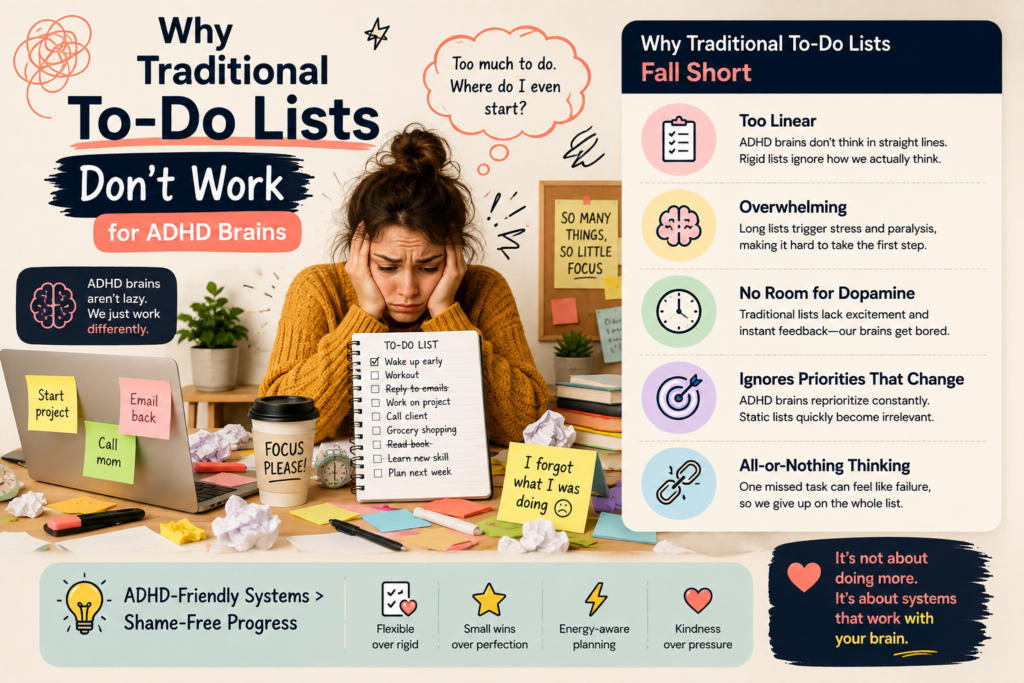
For millions of neurodivergent individuals, opening a traditional, linear to-do list brings a familiar wave of paralysis rather than productivity. You write down task after task, intending to check them off one by one, only for the paper to turn into a visual tally of personal failure by the end of the day.
If standard productivity advice like “just write a list and stick to it” leaves you feeling stuck, it isn’t a lack of willpower. Standard task-management systems were built around neurotypical executive functioning. For an ADHD brain, traditional to-do lists are practically designed to trigger cognitive overload.
The Architecture of the ADHD Executive Function Gap
To understand why standard lists fail, it helps to look at how an ADHD brain processes working memory, time, and motivation.
ADHD (Attention Deficit Hyperactivity Disorder) is fundamentally a dynamic of executive dysfunction—specifically involving the regulation of dopamine, working memory, and internal prioritization. Where a neurotypical brain sees a list of three simple tasks, an ADHD brain experiences structural friction across four distinct areas:
┌────────────────────────────────────────────────────────┐
│               ADHD TASK PARALYSIS                      │
├───────────────────┬───────────────────┬────────────────┤
│   NOW vs. NOT NOW │ OVERWHELM TRAP    │ DOPAMINE GAP   │
│ Time Blindness    │ Micro-step Blind  │ Flat Reward    │
└───────────────────┴───────────────────┴────────────────┘
1. Time Blindness (“Now” vs. “Not Now”)
Neurotypical brains naturally categorize time into granular blocks: past, present, next hour, tomorrow, next week. ADHD brains primarily operate in two temporal states: Now and Not Now.
A static, linear to-do list places items due in two hours right next to items due in three weeks. Because the ADHD brain struggles to intuitively map urgency over time, every single item on that paper registers with equal, immediate pressure. The result is instant cognitive fatigue.
2. Micro-Step Blindness & Initiation Friction
A single line item like “Clean the kitchen” seems simple to a neurotypical brain. However, an ADHD brain instantly breaks that single line into dozens of micro-decisions:
- Where do I put this mug?
- Do I have clean sponges?
- Should I unload the dishwasher top rack or bottom rack first?
Because the list item omits these micro-steps, the initiation cost skyrockets. The brain perceives the single bullet point as a massive, ambiguous mountain, leading to physical task paralysis.
3. The Flat Dopamine Landscape
Dopamine is the neurotransmitter responsible for motivation, task-initiation, and reward registration. Neurotypical brains get a steady trickle of dopamine simply from completing a routine task or crossing off a item.
An ADHD brain has a baseline dopamine deficit. Checking off “Pay electric bill” offers virtually no internal reward. Without an immediate threat (an impending deadline) or novelty/interest, the brain cannot mobilize the dopamine required to initiate the task.
Why Popular Productivity Hacks Backfire
Many standard productivity frameworks actually compound the problem for neurodivergent thinkers:
| Traditional Method | Why It Fails ADHD Brains |
|---|---|
| Eisenhower Matrix (Urgent vs. Important) | Requires constant higher-level meta-decisions. When everything feels like “Now,” prioritizing items into 4 distinct quadrants causes decision fatigue before work even starts. |
| Bullet Journaling (Strict layouts) | The setup maintenance requires sustained, low-dopamine executive function. When a day is missed, guilt sets in, leading to total abandonment of the system. |
| Massive Master Lists | Acts as a constant visual threat environment. The longer the list grows, the more it signals failure, triggering an emotional avoidance response. |
ADHD-Friendly Alternatives That Actually Work
Instead of forcing your brain to adapt to a system built for someone else, adapt the system to work with your neurobiology.
1. The “Top 3” Variable Buffer (Constraint-Based)
Never look at a master list during the working day. Keep a master dump file hidden away, and pull out a maximum of three non-negotiable items onto a sticky note for the day. Once those three are complete, anything else is bonus points. Reducing visual options lowers choice-paralysis.
2. Externalize Micro-Steps (Verb-First Lists)
Replace vague noun phrases with clear, immediate physical verbs that eliminate decision fatigue:
- ❌ Tax Return
- 🟢 Open laptop and log into bank account
3. Gamification and Visual Energy Trackers
Instead of organizing tasks by time, organize them by energy requirements:
- High-Dopamine / Deep Focus: Complex problem solving.
- Low-Brainpower / Low-Dopamine: Folding laundry while watching a YouTube video, clearing spam emails.
Match your task selection to your current physiological energy level rather than an arbitrary schedule.
Conclusion: Embrace Accommodations Without Guilt
Abandoning traditional to-do lists is not a sign of failure; it is an act of self-accommodation. Productivity is not about adhering to rigid paper formats—it is about creating an environment where your brain can comfortably initiate and finish work.
Stop fighting your neurology with systems that drain your battery. By shrinking your visual field, reducing initiation steps, and leaning into interest-based motivation, you can build a workflow that honors how your brain actually operates.
