
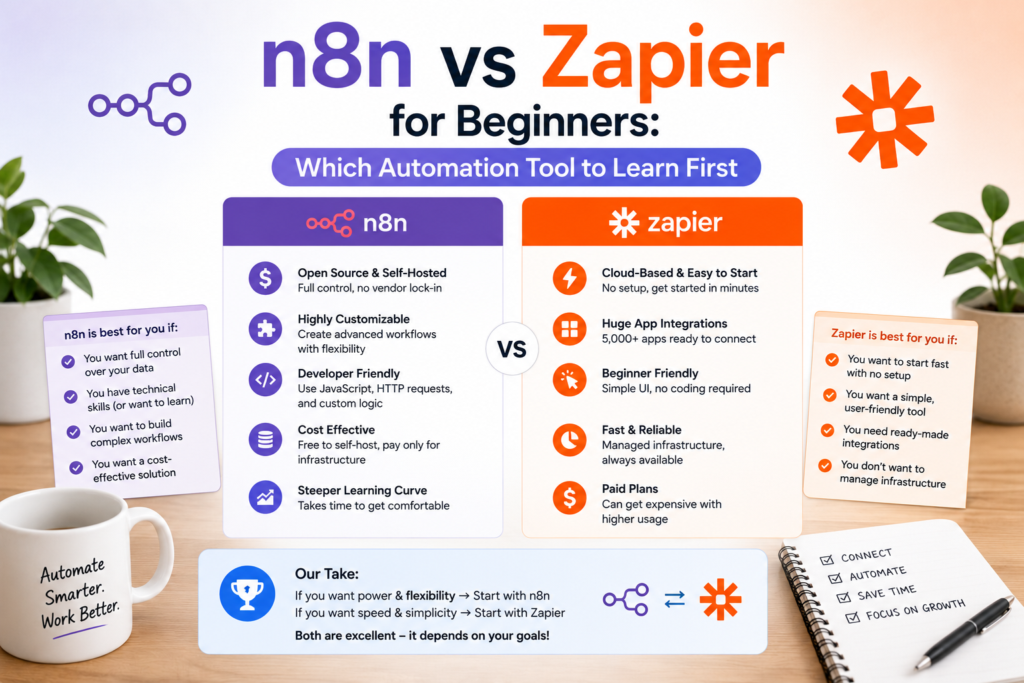
If you’re picking your first automation tool, the choice usually comes down to n8n and Zapier.
Both can connect your apps and eliminate repetitive manual work, but they’re built for different kinds of users, and the “right” one depends less on which is objectively better and more on how much technical comfort you’re starting with – and how much you expect to automate down the road.
Here’s how they actually compare for someone starting from zero.
The short answer
Zapier is the easier starting point for non-technical beginners. It’s cloud-only, has a simple point-and-click, trigger-and-action builder, and connects to thousands of apps out of the box. You can build a working automation in your first sitting with no learning curve.
n8n has more of a learning curve — it uses a visual, node-based canvas and expects some comfort with concepts like JSON data — but it’s more flexible, can be self-hosted for free, and tends to be far cheaper once you’re running a meaningful volume of automations.
If you want to be automating something useful within the hour, start with Zapier. If you’re comfortable with a bit of a technical ramp-up and want a tool that scales with you long-term without costs climbing fast, n8n is worth the extra initial effort.
How they’re actually different
Ease of use
Zapier’s interface is built around a simple idea: pick a trigger, pick an action, connect the two. There’s very little to learn conceptually, which is why it’s widely considered the most beginner-friendly option in the category.
n8n uses a canvas where you drag and connect nodes to build a workflow visually. It’s more powerful — you can branch logic, transform data, and chain complex multi-step flows — but that power comes with more surface area to learn, especially around how data passes between nodes.
Integrations
Zapier connects to several thousand apps natively, which matters a lot as a beginner: whatever tool you use is probably already supported with a guided setup.
n8n ships with several hundred native integrations, but it can connect to virtually anything else via a generic HTTP request node — you just need to be comfortable pointing it at an API, which is a more technical step than Zapier typically requires.
Pricing model — this is the part that surprises people
This is the single biggest difference, and it’s not just about the sticker price — it’s about how each tool counts usage.
- Zapier bills per task, where every individual action step in a workflow counts separately each time it runs. A five-step automation that runs a thousand times can consume thousands of billed tasks, so costs climb quickly once your workflows get longer or run often.
- n8n bills per execution, where an entire workflow run — no matter how many steps it contains — counts as a single execution. A twenty-step n8n workflow processing the same volume of work can cost meaningfully less than the Zapier equivalent.
For a beginner running a handful of simple automations, this difference barely matters. It becomes significant once you’re running many multi-step workflows regularly — which is often the point where people who started on Zapier look at switching.
Self-hosting
Zapier is cloud-only; there’s no option to run it yourself. n8n can be self-hosted for free (you cover your own server costs, often just a few dollars a month), which is a major cost advantage for technically comfortable users, though it adds setup and maintenance you won’t have with Zapier’s fully managed service.
Who each tool is really built for
Zapier is built for non-technical users who want automation working today, without writing code or thinking about infrastructure. n8n is built for people comfortable with a slightly more technical tool in exchange for more control, more flexibility, and meaningfully lower costs at scale.
A simple way to decide
Ask yourself two questions:
- Am I comfortable with a short learning curve in exchange for more flexibility and lower long-term cost? If yes, lean n8n. If you’d rather start automating in the next ten minutes with zero setup, lean Zapier.
- How much am I likely to automate? A handful of simple, occasional automations rarely justify the extra learning curve of n8n — Zapier’s simplicity wins. If you can already picture dozens of workflows running regularly across your business, n8n’s pricing model will save real money as you scale.
Many people also end up using both over time: starting on Zapier to validate that a given automation is worth building, then migrating cost-heavy or complex workflows to n8n once volume justifies the switch.
Frequently Asked Questions
Is n8n harder to learn than Zapier?
Yes, generally. Zapier’s guided trigger-and-action interface requires little to no technical background. n8n’s node-based canvas and JSON data handling ask more of a beginner, though its learning curve has been getting gentler as the platform’s interface has improved.
Is n8n really cheaper than Zapier?
It depends on your usage pattern. For light, occasional use, the two are often comparable in cost. For frequent, multi-step automations, n8n’s per-execution billing tends to come out significantly cheaper than Zapier’s per-task billing, and self-hosting removes subscription costs entirely (beyond your own server).
Can n8n do everything Zapier can do?
For most common workflows, yes — either through a native integration, a community-built node, or a generic HTTP request to the target app’s API. The difference is effort: Zapier’s integrations are typically more plug-and-play, while n8n sometimes requires a more hands-on setup for less common apps.
Do I need to know how to code to use either tool?
No, not for either one at a beginner level. Both are visual, no-code builders by default. n8n does offer optional code nodes (JavaScript/Python) for advanced logic, which Zapier also supports in a more limited form, but neither requires coding to get started.
Final thoughts
There’s no universally “better” tool here — just a better fit for where you’re starting from. If you want the fastest path to your first working automation, start with Zapier. If you’re willing to spend a bit more time learning up front in exchange for more flexibility and a pricing model that scales better, n8n is worth the investment. Either way, the real skill you’re building — thinking in triggers and actions — transfers directly if you ever decide to switch.
